Jun 8, 2010

Rampant Tut-mania in New York


Tutankhamun and the Golden Age of the Pharaohs," now on view in Manhattan until Jan. 2, 2011, has unleashed rampant Tut-mania in New York, just like it did at the exhibition’s previous seven stops. This is last venue for this touring blockbuster. A selection of about 50 pieces unearthed from the tomb of King Tut (ca. 1343 BC-1333 BC) is being shown with about 80 more items from the 18th Dynasty in Egypt.

Among the most intriguing pieces from Tut’s tomb is a painted wooden torso of Tut. He may have been considered both a god and a human being, but the human dominates in this startlingly realistic bust, wearing a royal crown and linen shirt, but without arms. It projects a lively presence, but its purpose is one of the many mysteries still unanswered about Tut.

But the most impressive pieces are the many fine gold, personal items found with Tutankhamun’s mummy. The show’s grand finale consists of a replica of the mummy chamber with a handful of finely wrought, mostly gold objects -- a jeweled pectoral, made of gold, silver, glass and semiprecious stones, a gold diadem, and a gold knife and sheath too delicate for this world but perfect for use in a royal afterlife among others.

This is the second Tut exhibition to tour the U.S. and very different from the earlier 1976-79 King Tut tour. Only a handful of pieces are the same, so fans of that show at the Metropolitan Museum will want to visit the Discovery Center to see the new material. This show also contains some of the latest scientific research on Tut. It’s explained along with a replica of Tut’s mummy at the very end of the exhibition.

The King Tut shows are more than simple cultural exchanges, of course; they’re designed for fundraising as well, and this tour should help pay for a new museum to house antiquities in Cairo. Admission is $27.50 for adults.

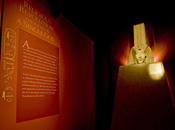
In publicity for the show, there is a golden statue of King Tut that looks like the gilded funerary mask of King Tut’s mummy, which appeared in the last exhibition. The golden mask won’t leave Cairo again by order of the Egyptian government. What you are actually seeing is a much smaller, but also exquisite piece, one of four miniature coffins for the viscera of Tut. The Egyptians embalmed the body, placing the heart back into it, but putting the stomach, intestines, and lungs and, in this case, the liver in separate containers.

Tut’s liver caffeinate is made of gold, with inlays of colored glass and carnelian, and obsidian and rock crystal for his eyes. He holds a flail, symbol of royal power, and a crook, symbol of the king as shepherd of his people. It measures only about ten inches high, yet it exudes power.

One of the favorite pieces isn’t made of gold. It’s a carved-calcite cylindrical cosmetic jar with a recumbent lion, representing the king, on the lid. Instead of feet, the jar rests on four heads of traditional enemies of Egypt, two Nubians of carved black stone, and two western Asians carved in red stone. The exterior walls of the vessel are incised and painted blue. They show a lion attacking a bovine with the help of dogs.

For Tut enthusiasts, the Metropolitan Museum of Art is presenting a show of finds from the embalming site of Tut, "Tutankhamun’s Funeral," through Sept. 2, 2010. The small show has more artifacts than art but the importance of floral collars and the beads they incorporated are worth a look.

Reference: an article written by N.F. Karlins

The river "Nile" and its crucial role in existence of the civilization


Without the Nile, Egypt may never have become one of the most extraordinary civilizations in history. The White Nile together with the Blue Nile which joins it in the south has a total length of about 1,913miles. The Blue Nile rises in the highlands of Ethiopia. Egypt is very hot and very dry. There is no enough rain in Egypt to help crops to grow, so the River Nile is very important to the Egyptians. Every year it rains hard in the distant mountains to the south. In the summer, water comes rushing down the Nile into Egypt. The river bursts its banks and floods the farm land on either side. The Egyptian people have always used irrigation. In this way they can make the best use of the flood waters. The Ancient Egyptians dug ditches which ran through their fields. They built reservoirs to store the water. Men and woman called conscripts were made to help with this work. By 3100 B.C the Nile Valley and Delta had coalesced into a single entity that was the world's first large nation state. As well as providing the region's material potential, the Nile and other geographical features influenced political developments and were significant in the development of Egyptian thought. The land continued to develop and its population increased until Roman times. Important factors in this process were unity, political stability, and the expansion of the area of cultivated land. The harnessing of the Nile was crucial to growth. It is uncertain how early and by how much the inundation was regulated. The Nile's annual inundation was relatively reliable, and the floodplain and Delta were very fertile, making Egyptian agriculture the most secure and productive in the Near East. When conditions were stable, food could be stored against scarcity. The situation, however, was not always favorable. High floods could be very destructive; sometimes growth was held back through crop failure due to poor floods; sometimes there was population loss through disease and other hazards. Contrary to modern practice, only one main crop was grown per year. Crops could be planted after the inundation, which covered the Valley and Delta in August and September; they needed minimal watering and ripened from March to May. Management of the inundation in order to improve its coverage of the land and to regulate the period of flooding increased yields, while drainage and the accumulation of silt extended the fields. Vegetables grown in small plots needed irrigating all year from water carried by hand in pots and from 1500 BC by artificial water-lifting devices. Some plants, such as date palms, whose crops ripened in the late summer, drew their water from the subsoil and needed no other watering.

References: the story of the Nile by John Baines

Ancient Egypt by Martin Forrest


Jun 5, 2010

Abu Simbel and the miracle of the sun


The temple of Abu Simbel is an exact transferal of the architectural formOf an Egyptian inner sanctuary temple cut deep inside the rock. Sculpted into the mountain, the façade is 38 meters long and 31 high. This is framed by a convex "torus " moulding , and is surmounted by a cornice with uraei (the sacred asp) above which is carved a row of 22 seated baboons , each two and a half meters high. Below the torus moulding is a cornice engraved with dedicatory hieroglyphics, and in a niche below this in the middle of the façade is a large high – relief statue representing Ra- Harakhati with a falcon's head flanked by two – relief figures of Ramses II. Four colossal statues of Ramses II seated form the supporting columns of the façade. Even on this monumental scale they produce the true features of the monarch. They are 20 meters high and measure more than 4 from ear to ear, while the lips, measuring over a meter, express a soft, gentle smile. The pharaoh is represented with his hands resting in his lap wearing the double crown and a headdress with deep folds on either side of his face. The second statue on the left is broken and part of the head and body lie on the ground. Beside and between the legs of each colossus are other statues representing members of the royal family including a daughter (who was also his wife) Bent'anat , his mother Tuya , his wife Nefertari , his son Amenhirkhopshef, and another daughter and wife, Merytamun. On the base and along the sides of the seats are figures of African and Asiatic prisoners. A multitude of workers imprisoned by his sword "worked on the monumental façade under the orders of Pyay , head of the sculptures , as we read inside the temple. The work of the sculptures was followed by that of the painters for, at the time of Ramses, the temple was most probably richly painted and decorated

The interior

On passing to the interior, the shadowy light emphasizes the mysterious and evocative atmosphere. The "pronaos" is a vast rectangular hall 18 meters long and 16.70 wide. This is flanked by eight Osiris pillars ten meters tall arranged in two rows, representing Osiris with the features of Ramses. The colossi on the left wear the white crown of Upper Egypt, those on the right, the "pschent" or double crown. Their arms, crossed over their chests, hold the scepter and flail. Decorating the roof of the central nave is the great vulture of the goddess Nekhbet, protrectress of Upper Egypt, while the aisles on either side are painted with stars.

Sanctuary and the miracle of the sun
Sixty – five meters from the entrance, deep in the heart of the mountain, is a sanctuary, the most intimate and secret part of the temple, a small room four meters by seven. Here sits the statue of the deified Ramses II together with the triad of "Ptah", "Amoun-Ra" and "Harmakhis".
It was obvious ever since discovery in the 19th century that nothing in this temple was left to chance and that it was built according to a very precise logic and pre-established plan.
Francois Champollion was the first of several scholars to note what has become known as the "miracle of the sun".
"Abu Simbel" was built along a pre- determined axis: twice a year, corresponding to the equinoxes, the rising sun penetrates the heart of the mountain and illuminates the statues in the sanctuary. The first rays of the sun follow the axis of the temple precisely, crossing its entire length and gradually flooding the statues of "Amon", "Harmakhis" and the pharaoh in light. It takes about twenty minutes for the light to pass, yet remarkably Ptah is never struck by the sun's rays. Ptah is, in fact, the god of darkness and the dead.